HomeBlog & ResourcesPool Cage Lighting Ideas for Florida Homes: Options, Costs, and What Actually Works
Design & Trends
Sep 2026 13 min read
Pool Cage Lighting Ideas for Florida Homes: Options, Costs, and What Actually Works
Low-glare LEDs, focused zones, and warm white - the layout that actually works after dark.
Screen Factory Team
Licensed Contractor
How Do You Light a Pool Cage the Right Way?
The short answer: what works for most Florida pool cages
Compare seven pool cage lighting ideas
Build the plan in layers, not by fixture count alone
Warm white or RGBW: which color system makes sense?
Planning lighting for a new pool cage versus an existing enclosure
How to compare lighting systems without relying on a brand name
Florida weather and electrical safety
Pool cage lighting cost: current promotional pricing
Real project example: integrated lighting in a two-story Sanibel enclosure
Pool cage lighting FAQ
Plan a pool cage lighting estimate
How Do You Light a Pool Cage the Right Way?
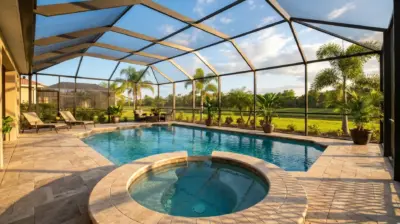
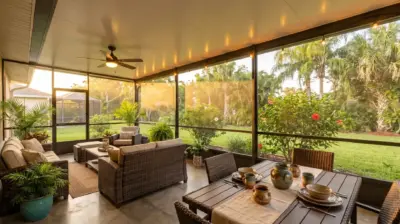
Most pool cages are designed for daylight. After sunset, one wall light can glare across the deck, the far corners disappear, and the screen reflects more patio than view. Good pool cage lighting fixes that with several quieter layers instead of one oversized fixture.
For most Florida pool cages, the most practical plan combines low-glare, outdoor-rated LED fixtures on selected posts or beams with focused lighting at doors, steps, seating, and cooking areas. Warm white light usually feels best for everyday evenings. RGBW control is useful when you want adjustable colors for entertaining, but it should be an option within the plan, not the only reason for the plan.
The short answer: what works for most Florida pool cages
The best layout starts with how the space is used, then assigns a job to every fixture. General light supports movement, task light serves a grill, table, step, or door, and accent light draws attention to palms, architecture, or water.
A balanced plan usually includes:
low-glare light around the enclosure instead of one harsh source;
brighter, deliberate light at steps, doors, and work surfaces;
a warmer everyday setting for dining and conversation;
dimming or separate zones so the whole system does not have to run at full brightness;
fixtures, wiring, connectors, and controls suited to outdoor conditions;
serviceable components that can be replaced without rebuilding the entire system.
The biggest mistake is choosing fixtures before choosing their purpose. A bright row can illuminate the deck and still feel uncomfortable. A smaller, better-positioned system can feel more finished because it controls glare and preserves contrast.
Compare seven pool cage lighting ideas
No single option is right for every enclosure. Height, frame layout, screen reflections, nearby rooms, deck features, and the homeowner's preferred atmosphere all affect the choice.
Lighting idea
Best use
Main advantage
What to watch
Post-mounted LED lights
Everyday ambient light
Even, familiar illumination
Eye-level glare if fixtures are too bright
Integrated downlights
New cages and clean architectural layouts
Light is aimed toward the deck
Placement should be planned before construction
Linear LED lighting
Modern roof lines and subtle perimeter glow
Visually continuous effect
Heat, water protection, and service access
Perimeter uplighting
Palms, landscaping, and frame accents
Adds depth without flooding the deck
Beam direction and screen reflections
Task lighting
Steps, doors, grills, and tables
Improves function where it matters
Needs its own placement and sometimes its own zone
Underwater lighting
Pools and water features
Creates a strong visual focal point
It complements cage lighting but does not replace it
String or solar lights
Temporary atmosphere or a small budget
Easy decorative effect
Attachment, wind movement, durability, and cable appearance
1. Post-mounted LED lights
Post-mounted lights are a dependable starting point because the enclosure already provides a rhythm of vertical members. Selective spacing can create a comfortable perimeter without making the cage look busy.
The important detail is glare control. A bright source near seated eye level can dominate the view. Shielding, thoughtful mounting height, and dimming matter more than the highest lumen number. A fixture that visually disappears against white or bronze aluminum also keeps the cage from looking cluttered during the day.
2. Integrated downlights
Integrated downlights are a clean choice for a new pool cage because lighting, wiring, frame, screen, and gutter work can be coordinated before installation. Light falls where people walk and gather while the hardware remains visually quiet.
This is especially useful in tall enclosures, but height changes the design. A fixture far above the deck must be selected and aimed for that distance. More output alone can create bright spots surrounded by darkness, so beam control matters as much as fixture count.
3. Linear LED lighting along beams or roof lines
Linear LED lighting can emphasize the cage geometry and create a soft background glow without a row of visible fixtures.
The channel should look intentional in daylight, wiring should not wander across the frame, and the system needs outdoor-suitable protection, compatible components, heat management, and service access. Continuous light works only when the installation stays clean and maintainable outdoors.
4. Perimeter uplighting and landscape lighting
Perimeter uplighting works when the view beyond the screen matters as much as the deck. Lighting a palm, planting bed, or architectural feature gives the eye somewhere to travel and can reduce the mirror-like effect of a bright patio surrounded by darkness.
Aim is critical. A beam directed into a screen panel can create reflections or reveal every strand of mesh. Light the feature, not the screen, and pair this accent layer with quieter general lighting inside the enclosure.
5. Task lighting for steps, doors, and cooking areas
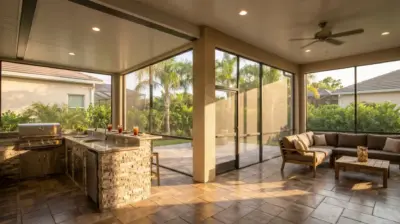
Task lighting solves problems decorative lighting misses. A step needs contrast, a latch should be easy to find, and a grill needs light on the work surface rather than in the cook's eyes.
Accurate placement matters more than matching the rest of the cage. A separate control zone can also light the grill without turning the entire enclosure into an event space.
6. Underwater and water-feature lighting
Underwater lights can become the visual center of the nighttime scene, but they do not reliably illuminate a doorway, table, deck transition, or grill area.
Treat the pool as one accent layer and balance it with low-glare light around the enclosure. If the water is much brighter than everything else, the deck can feel darker. Separate controls let the two systems suit a quiet evening, active swimming, or a gathering.
7. String and solar lights
String and solar lights provide an inexpensive decorative layer. Their charm comes from visible points of light, not precise task illumination.
Cords and clips can look messy in daylight, lightweight strands can move in wind, and outdoor durability varies. Protect the screen and aluminum finish, use products listed for the intended location, follow the manufacturer's instructions, and do not improvise permanent wiring around a pool.
Build the plan in layers, not by fixture count alone
A useful lighting plan combines ambient, task, and accent light, then gives the homeowner control over those layers. Fixture count matters for pricing, but it is not a design by itself.
Start with the most frequent evening activities. Outdoor dining needs comfortable light over the table and along the path from the house. A homeowner who mostly looks out from an interior room may prefer low-glare accents and a clear nighttime view. A frequent entertainer may want multiple zones and color scenes.
Then map darker transitions: the step to the deck, the screen door, the equipment route, and the edge between the covered lanai and open cage. These are better candidates for focused light than the middle of an already illuminated deck.
Finally, decide what can stay dark. Contrast is part of good exterior lighting. If every post, beam, palm, wall, and water feature is equally bright, the space loses depth. A calmer plan highlights the places people use and lets the rest of the enclosure recede.
Warm white or RGBW: which color system makes sense?
Warm white is the safest everyday choice for dining, conversation, and a relaxed residential setting. RGBW adds red, green, and blue color channels plus a dedicated white channel, so one system can provide both usable white light and decorative color scenes.
Choose warm white or tunable white for a natural, consistent atmosphere. It works well with stucco, wood tones, landscaping, and warm interior light. Dimming usually adds more everyday value than extreme brightness.
Choose RGBW when the household will use color for holidays, parties, or changes of mood. Look for a comfortable dedicated white setting and controls that let anyone restore the everyday scene without rebuilding it in an app.
Color temperature and color control cannot correct poor placement. A glare-heavy fixture remains glare-heavy in any color. Plan direction, shielding, and zones first, then choose the control features that suit the household.
Planning lighting for a new pool cage versus an existing enclosure
Lighting can be added to many existing pool cages, but a new enclosure offers the cleanest opportunity to coordinate routing, fixture positions, access, and controls before screen and gutter work is complete.
For a new cage, discuss lighting while the enclosure is being designed. The frame layout determines where fixtures can sit, and an early plan can reduce visible wiring and conflicts with screen panels, gutters, doors, and structural connections. Screen Factory Florida’s custom screen pool enclosures in Florida page explains the broader enclosure options that can be coordinated with lighting.
For an existing cage, start with a condition check rather than assuming the frame is ready. Useful questions include:
Where can the wiring travel cleanly and remain serviceable?
Are the preferred mounting points structurally and visually appropriate?
Will the light aim across a screen panel or into a neighboring room?
Is there a suitable path to power and controls?
Can the system be installed without damaging screen, paint, gutters, or doors?
For lighting-only inquiries, Screen Factory Florida can prepare the estimate calculation from clear photos. A separate measurement visit is not required solely for the lighting estimate. Photos should show the entire enclosure from several angles, the house connection, frame color, doors, steps, seating or kitchen zones, and any areas that feel too dark at night.
How to compare lighting systems without relying on a brand name
A quality pool cage lighting system is defined by the suitability and compatibility of the complete assembly, not by a logo alone. Good and poor products exist across the market, so compare the practical details that determine how the system will look, operate, and be maintained.
Ask these questions before choosing:
Is every exposed component suitable for the intended outdoor or wet location?
Are the fixtures, power supply, controller, wiring, and connectors designed to work together?
How are connections protected from water intrusion and corrosion?
Can one failed fixture or lighting section be replaced without replacing the entire system?
Are replacement parts and compatible controls likely to remain available?
Does the system dim smoothly at the low settings used most evenings?
If it includes RGBW, does it also create a comfortable dedicated white light?
Will channels, clips, fasteners, and wiring look clean against the cage in daylight?
What written product and workmanship coverage applies to the quoted system?
For a permanent installation, inaccessible connectors, mismatched components, and proprietary parts with no replacement path can cost more later. The proposal should explain what is being installed, where it will go, how it is controlled, and what can be serviced.
Florida weather and electrical safety
Pool cage lighting must be selected and installed for outdoor exposure, moisture, heat, wind-driven rain, and the added electrical considerations of a pool environment. “Low voltage” does not mean “no rules,” and an indoor-rated product does not become suitable outdoors because it sits under a screen roof.
UL distinguishes outdoor lighting by system type and evaluates line-voltage luminaires for wet-location use under UL 1598, while low-voltage landscape lighting systems and components are evaluated under standards such as UL 1838 and UL 2108. The practical lesson is simple: use a complete, compatible system suited to its location, not a collection of parts that happen to connect.
Florida’s pool-safety guidance states that electrical equipment, wiring, bonding, and grounding must comply with the applicable Florida Building Code requirements. The exact installation and permit path depends on the system, voltage, placement, and local jurisdiction. Permanent or hardwired electrical work should be handled within the scope of an appropriately licensed professional, and local permit requirements should be confirmed before work begins.
Homeowners do not need to memorize code tables. Ask the installer to identify the system, explain the power and control path, confirm the suitability of exposed components, and state who handles any required electrical or permit work.
Pool cage lighting cost: current promotional pricing
Screen Factory Florida’s current promotional pool cage lighting pricing starts at $2,210 for five lights. Ten lights are currently listed at $2,860, and 15 lights at $3,900. The minimum package is five lights; a smaller installation is priced as five. Projects requiring more than 15 lights are quoted individually.
Number of lights
Previous price
Current promotional price
5
$4,420
$2,210
6
$4,680
$2,340
7
$4,940
$2,470
8
$5,200
$2,600
9
$5,460
$2,730
10
$5,720
$2,860
11
$6,760
$3,380
12
$7,020
$3,510
13
$7,280
$3,640
14
$7,540
$3,770
15
$7,800
$3,900
Pricing updated September 2026. Promotional pricing and availability may change. Final scope and pricing are confirmed in the signed invoice. The table should be read by package size, not as a fixed per-light formula, because the listed price steps are not uniform.
For lighting-only work, the estimate can be calculated from photos. Work begins after the invoice is signed, with no deposit, and payment is due in full after completion. Final price can depend on enclosure height, layout, fixture positions, routing, access, controls, power requirements, and visible conditions.
Real project example: integrated lighting in a two-story Sanibel enclosure
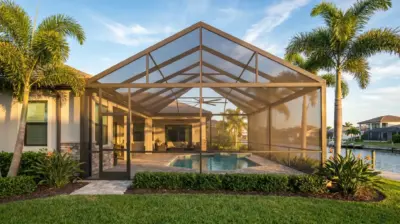
Project #4245 shows why early lighting coordination matters in a large structure. Screen Factory Florida completed the 65-by-30-foot enclosure in Sanibel on January 30, 2026. The two-story cage reaches approximately 20 feet high and includes 14 large Picture View panels, a mansard roof, Super Screen, a 7-inch Super Gutter, stainless fasteners, K-braces, support cables, and a perimeter concrete footing.
Because lighting was part of the design, wiring was coordinated before the screen and gutter work. The final lighting function was checked at completion. That sequence helped the lighting read as part of the enclosure rather than as an accessory added after the visible surfaces were finished.
The lesson applies beyond tall structures. Even on a single-story cage, early decisions about fixture location, control zones, and wire paths can produce a cleaner result. See the completed two-story Sanibel enclosure with integrated lighting for the full project scope.
What is the best type of lighting for a pool cage?
For most Florida pool cages, start with an outdoor-rated, low-glare LED system and address general light and task areas separately. Fixture type depends on cage height, frame layout, power access, screen reflections, and color preference.
Can lights be added to an existing pool enclosure?
Yes, lighting can be added to many existing pool enclosures when the frame, mounting points, wiring route, power source, and fixture locations support a clean installation. Full-cage and use-area photos are the fastest way to begin an evaluation.
How much does pool cage lighting cost?
As of September 2026, Screen Factory Florida’s promotional pricing ranges from $2,210 for five lights to $3,900 for 15 lights. Five lights is the minimum package, and projects with more than 15 lights require an individual quote. Pricing and availability may change, and the signed invoice confirms the final scope.
Is warm white or RGBW better for a pool enclosure?
Warm white is usually better for everyday dining and relaxation, while RGBW is useful for homeowners who will use color scenes for entertaining or holidays. If choosing RGBW, look for a dedicated white channel, smooth dimming, and controls that make the normal evening setting easy to restore.
Are string lights a good option for a pool cage?
String lights can provide temporary atmosphere, but they are not a complete lighting plan. Use products intended for the outdoor location, follow the manufacturer’s instructions, protect the screen and finish, and avoid improvised permanent electrical work.
Do pool cage lights require a permit or licensed electrical work?
The answer depends on the system, voltage, wiring method, placement, and local jurisdiction. Permanent or hardwired work should be evaluated and completed within the scope of an appropriately licensed professional, and the local authority should confirm whether a permit is required for the proposed installation.
Plan a pool cage lighting estimate
A useful estimate starts with the enclosure and the way you want to use it after dark. For an existing cage, send clear daytime photos from several angles and note the doors, steps, dining table, grill, seating area, and any dark zones. If possible, include one nighttime photo showing the current lighting problem. Screen Factory Florida can use those photos to calculate a lighting-only estimate without a separate measurement visit.
For a new enclosure, bring up lighting during the design conversation so fixture locations and wiring paths can be coordinated before screen and gutter work. In either case, the final proposal should identify the number of lights, system type, controls, installation scope, and payment terms. To start, request a pool cage lighting estimate.